This topic includes:
RDM options include settings regarding the RDM protocol and RDM standard itself.
These include parameters that cannot be set automatically or should be adjusted by the user.
In addition, there are user-definable settings regarding software behavior.
▪Go to the menu Preferences > Options... > RDM
[Keyboard shortcut: Ctrl + Alt + O > RDM]
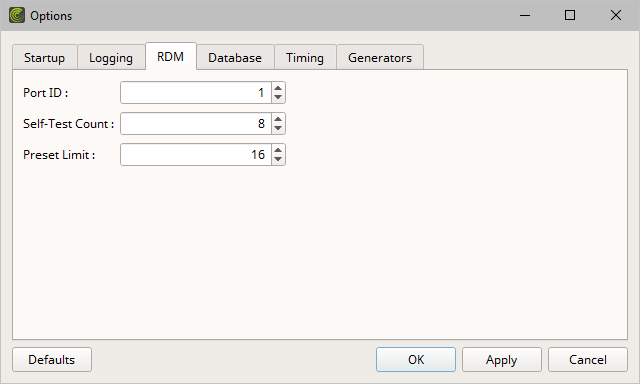
▪Set up the options as explained below.
▪Restore the default settings via Defaults.
▪Confirm any changes with OK or Apply. Discard any changes via Cancel.
General
▪Port ID - Defines the specific identification number for MADRIX RADAR as an RDM controller to be able to distinguish between possibly multiple RDM controllers in the network.
[Valid values range from 1 to 255. This option is set to 1 by default.]
▪Sending Frame Time (ms) - Defines the minimum time interval between 2 RDM data packages on a DMX line in milliseconds [ms].
- If this value is set too low, hardware interfaces may receive too many data packages, which can result in overload.
- If this value is set too high, the maximum possible data transfer rate will not be reached, which can unnecessarily increase the time required to obtain RDM information and data.
- Is mainly defined by the used hardware interfaces. As such, it is recommended to choose the lowest common denominator across all connected interfaces.
[Valid values range from 25 to 1000. This option is set to 50 ms by default.]
▪Transaction Timeout (s) - Defines the maximum allowed time interval for RDM communication and transactions in seconds [s]. Transactions include the RDM request of the controller as well as the reply/response of the responder.
- Any response that is received after this interval will be discarded and cannot be assigned to the original request anymore.
- If this value is too low, all packages could be discarded in extreme cases.
- If this value is too high, responses may be assigned incorrectly to unrelated requests.
- The timeout correlates to the RDM Frame Time and the number of RDM devices connected to a single DMX port of a hardware interface. The higher the RDM Frame Time and the more devices are connected to a single port, the longer a response can take.
[Valid values range from 1 to 30. This option is set to 13 s by default.]
▪Self-Test Count - Defines the highest number regarding self-tests that is queried from devices. Refers to the parameter Self-Test that may be reported by RDM Responders.
- RDM devices can include a number of self tests as defined and implemented by the manufacturer. These don't necessarily have to be numbered consecutively and there is no recommend maximum count.
- As such, you may want to choose to query for all 254 possible tests all the time. However, please note that this can drastically increase the network traffic depending on the number of available RDM devices in the network.
[Valid values range from 0 to 254. This option is set to 8 by default.]
▪Preset Limit - Defines the highest scene number that is queried from devices.
- RDM devices can include a number of scenes as defined and implemented by the manufacturer. These don't necessarily have to be numbered consecutively.
- As such, you may want to define the cap accordingly. However, please note that a high number can drastically increase the network traffic depending on the number of available RDM devices in the network.
[Valid values range from 0 to 65534. This option is set to 16 by default.]
Generator
Generators refer to the built-in systems in MADRIX RADAR that automatically create and generate RDM data packages [that is, RDM requests] which are sent to the RDM devices.
In fact, RDM devices only provide replies after receiving such requests. RDM devices will not independently send data packages to a receiver, such as MADRIX RADAR.
▪Preset - Allows you to choose and customize 2 different sets of settings. Choose from Maintenance and Monitoring.
- Maintenance includes much shorter time intervals by default and is recommended when actively and temporarily checking on a project in order to quickly see and receive information, notifications, and data updates.
[As such, this generates much more RDM requests and thus much more data traffic on the network as a result.]
- Monitoring includes much longer time intervals by default and is recommended when passively monitoring a project in order to be able to receive notifications on a regular basis and also for recording historical data.
▪Request Parameters Every - Defines the time interval at which all generic RDM parameters of the project are being queried/refreshed.
- Reference Time - In addition, you can set the start time/time interval/offset. [The default value is 12:00.]
- For example, updating values every 4 hours, starting at 12:00 will trigger the update 12:00, 16:00, 20:00, 24:00, 04:00, 08:00.
[Valid values range from 60 seconds to 24 hours. The default value for this option is 1 minute for Maintenance. The default value is 24 hours for Monitoring.]
▪Request Sensor Values Every - Defines the time interval at which sensor values of all known sensors of the project are being queried/refreshed.
- Reference Time - In addition, you can set the start time/time interval/offset. [The default value is 12:00.]
- For example, updating values every 4 hours, starting at 12:00 will trigger the update 12:00, 16:00, 20:00, 24:00, 04:00, 08:00.
[Valid values range from 60 seconds to 24 hours. The default value for this option is 1 minute for Maintenance. The default value is 1 hour for Monitoring.]
- Store History - Allows you to record data over time. This requires the MADRIX RADAR big data license. If disabled and/or no corresponding license is available, previous values will always be overwritten with corresponding new values. Learn more »History
[Historical data can include sensor values as well as sensor value events.]
▪Request Status Messages Every - Defines the time interval at which the status messages of all known devices of the project are being queried/refreshed.
- Reference Time - In addition, you can set the start time/time interval/offset. [The default value is 12:00.]
- For example, updating values every 4 hours, starting at 12:00 will trigger the update 12:00, 16:00, 20:00, 24:00, 04:00, 08:00.
[Valid values range from 60 second to 24 hours. The default value for this option is 1 minute for Maintenance. The default value is 1 hour for Monitoring.]
- Store History - Allows you to record messages over time. This requires the MADRIX RADAR big data license. If disabled and/or no corresponding license is available, previous values will always be overwritten with corresponding new messages. Learn more »History
▪All RDM options will be saved locally on your computer.
| MADRIX RADAR User Manual 1.5. |
| [Ctrl & +/-] = Zoom In/Out | [Ctrl & 0] = 100% |
|
Previous Next
|
|
Enable Automatic Translation | Activer La Traduction Automatique | 启用自动翻译 |